
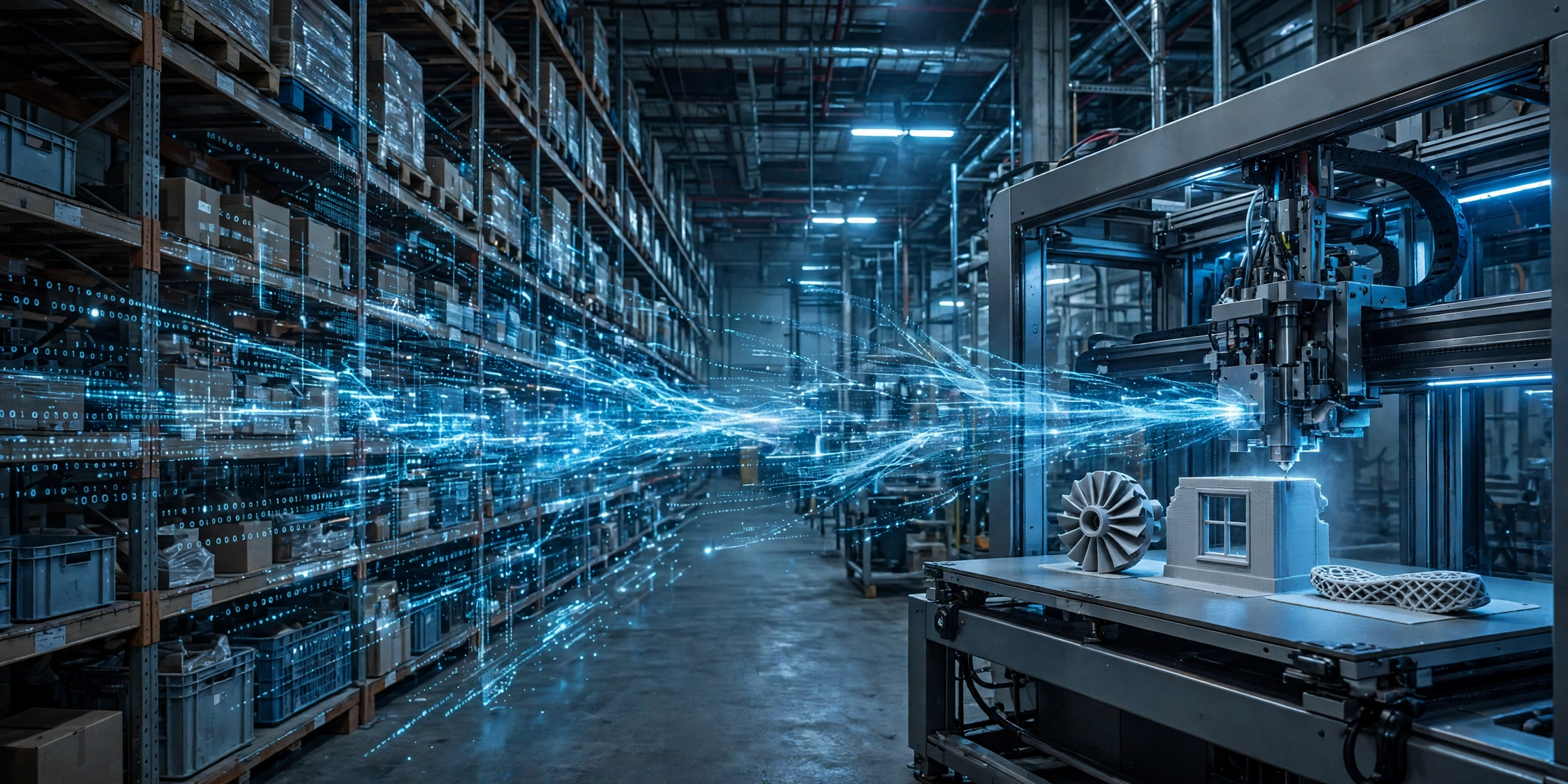
For a century, the supply chain ran on a simple bet: guess what customers will need, make a lot of it somewhere cheap, ship it slowly, and store it until someone buys it. Tooling, freight and warehouses were just the cost of playing.
Additive manufacturing breaks every part of that bet. The inventory becomes a digital file. The factory becomes a printer that can sit anywhere. The lead time becomes a print cycle. And in seven industries, the shift has gone so far that going back is no longer a serious option — not because printing is fashionable, but because the economics, certifications and customer expectations have already moved. As our Q4 2026 industry snapshot shows, the capital has noticed too.
Here is where it happened — and what it means for builders.
1. Aerospace and Defense: Certified, Consolidated, Locked In
Aerospace gave 3D printing its hardest test — parts that fly — and never looked back. GE Aerospace famously consolidated its LEAP engine fuel nozzle from 20 separate parts into a single printed piece that is roughly 25% lighter, and it has since shipped well over 100,000 printed nozzle tips. Once a part is designed and certified as a printed part, there is no “old way” to return to — the conventional version no longer exists as a design.
Relativity Space pushed the logic further, building its Terran R rocket program around large-format metal printers and treating the rocket itself as a printed structure rather than an assembly of sourced components. The lesson for founders: in aerospace, printing wins on part consolidation and weight — and certification turns that win into a moat.
2. Hearing Aids: The Total Takeover Nobody Noticed
If you want proof an industry can flip completely, look inside your ear. Custom hearing aid shells used to be made by hand — poured, ground and polished by technicians. Today, effectively every custom shell in the industry is 3D printed: the ear impression is scanned, modeled and printed overnight. Industry estimates put printed shells at well over 90% of the global market, and the transition took only a few years.
Sonova, the group behind Phonak, built its custom production around this digital workflow — as did every serious competitor. Nobody proposes going back to hand-pouring shells: when fit is personal and volume is high, printing is not an experiment. It is the industry.
3. Dental: A Factory That Ships One-Offs
Dentistry runs on parts unique to one patient’s mouth — the worst possible fit for mass production and the perfect fit for printing. Align Technology built the Invisalign system on exactly that insight: every aligner is different, and the company manufactures hundreds of thousands of those one-of-a-kind parts every day. There is no injection-molding version of that business at any price.
Formlabs and its peers moved printing into the dental lab and clinic, where dentures, models, crowns and surgical guides are now printed in-house instead of outsourced and shipped. For a growing share of dental work, the supply chain is a printer in the back room and a file from the scanner.
4. Automotive: The Tooling Beachhead
Cars are still stamped and molded by the million — but the supply chain around the car has been eaten from the inside. Ford uses additive manufacturing for prototypes, assembly jigs and fixtures, and low-volume and service parts — where printing a bracket in days beats commissioning hard tooling that takes months.
The pattern: printing enters through tooling and low-volume parts, proves itself on lead time, then takes the spare-parts catalog. A replacement part for a fifteen-year-old model no longer needs a warehouse shelf or a production re-run — it needs a validated file. For suppliers, the threat and the opportunity are the same: the catalog is becoming digital.
5. Construction: Printing the Walls Where They Stand
Construction’s supply chain problem is that the product is enormous, local and labor-hungry. Printing attacks all three. ICON has printed entire neighborhoods, including a 100-home community in Georgetown, Texas — the largest 3D-printed housing development of its kind — using a gantry printer that builds walls on site from a digital plan. (Our 3D printed homes coverage has tracked the shift from novelty to production.)
COBOD sells the picks and shovels: its construction printers are installed in more than 35 countries, printing everything from houses to large concrete water tanks with locally sourced concrete instead of a proprietary mix shipped around the world. When the factory rolls onto the lot and the main material is local, manufacturers, distributors and freight simply have less to do.
6. Footwear and Consumer Goods: Performance You Can’t Mold
Some printed products are not cheaper versions of old ones — they are products that could not exist before. The lattice midsole in the adidas 4DFWD running shoe, printed with Carbon‘s resin technology, is tuned from athlete data and produced as a single complex structure no mold can make. Carbon’s platform also sits inside Riddell football helmets, where printed lattice liners are fitted to the individual player.
The supply-chain consequence is subtle but deep: no molds means no mold lead times, no tooling minimums, and product iterations measured in weeks instead of seasons. Design data flows straight into production — the distance between “we designed it” and “we ship it” keeps shrinking.
7. Rail and Industrial Spare Parts: The Warehouse Becomes a File
The most valuable beachhead of all may be the least glamorous: spare parts for machines that must run for decades. Siemens prints replacement parts for rail operators through its mobility service business, turning parts that once took weeks of machining — or were simply obsolete — into on-demand prints delivered in days. Materialise runs certified production for medical and industrial customers who need exactly that reliability at low volumes.
The economics are brutal for the old model:
- A slow-moving part ties up warehouse cash for years — or it is printed when ordered
- An obsolete part can idle a train, a production line or a machine worth millions
- A validated digital file costs almost nothing to “stock” in every service depot at once
Multiply that across every fleet, factory and hospital running aging equipment, and digital inventory stops being a pilot project.
The Insight: The Moat Moved
The warehouse of the future is a file server — and the companies that own the validated files own the market.
Look at what the seven industries share. In each case, printing won where at least one of four conditions held:
- Every unit is different — aligners, hearing aids, patient-specific devices
- Volumes are low but the part is critical — aerospace components, rail spares
- The geometry is impossible to mold or machine — lattices, consolidated assemblies
- Lead time is the real cost — tooling, construction, service parts
And in each case, the durable advantage was not the printer. Printers get cheaper every year. The advantage is the validated file, the certified process and the customer relationship — assets a startup can build without owning a factory. That is why the founder opportunity is rarely “buy printers and undercut everyone.” It is picking an unglamorous niche where one of the four conditions bites hard, owning the digital inventory for it, and becoming the certified source everyone else has to call. New to this? Start with what it takes to start a 3D printing business.
Start with the parts nobody brags about: the obsolete bracket, the discontinued housing, the tool the factory waits six weeks for. That is where the supply chain already broke — and where the replacement businesses are being built.
Build the Business That Replaces the Chain
The supply chain is not coming back for these seven industries. The only question is who owns the files, the certifications and the customer relationships in the markets still waiting for the same flip — and a large share of those owners will be startups, not incumbents.
Go deeper:
- 3D Printing MBA — Expanded Edition ($97): a 236-page Expanded Business Textbook (also provided as six individual volumes), a 65-page Expanded Book, and a 16-page fillable workbook with 68 form fields — the complete operating system for launching and scaling a 3D printing business. Get the 3D Printing MBA on Gumroad
- Free 3D Printing Starter Kit: map your first move before you spend a dollar on equipment. Download the free Starter Kit
Want to make this practical? Explore our startup resources or 3D Printing MBA.