


The AI of Things Meets 3D Printing
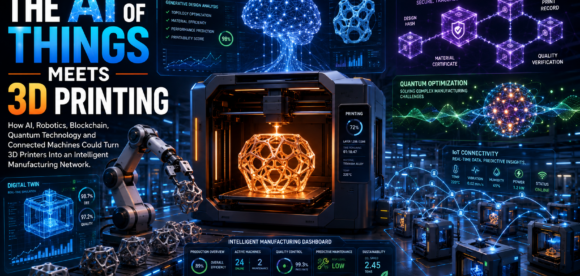
The AI of Things Meets 3D Printing
How AI, Robotics, Blockchain, Quantum Technology and Connected Machines Could Turn 3D Printers Into an Intelligent Manufacturing Network
For years, the Internet of Things promised a world where machines could sense, communicate and respond.
3D printing is now moving that idea into manufacturing.
A connected printer can already report temperature, material usage, machine status, camera feeds and job progress. Add artificial intelligence, robotics, digital twins and secure data infrastructure, and that printer stops looking like an isolated machine.
It starts looking like a node in an intelligent manufacturing network.
That is the bigger idea behind what we might call the AI of Things for 3D Printing: printers, sensors, software, robots and digital files connected by intelligence rather than simply connectivity.
“The Internet of Things connected machines. The AI of Things gives those machines context, judgment and the ability to improve.”
For 3D printing, that distinction could be enormous.
From Connected Printers to Intelligent Printers
The original Internet of Things model was fairly simple:
A machine collects data.
The data travels somewhere else.
Software analyzes it.
A person decides what to do.
The next phase compresses that loop.
AI increasingly allows manufacturing systems to interpret sensor data, identify abnormalities, predict quality issues and assist with control decisions. NIST’s 2026 roadmap for AI and machine learning in smart manufacturing specifically highlights additive manufacturing, robotics, digital twins, autonomous systems, sensing and supply-chain optimization among the areas where AI is becoming increasingly important.
That matters because 3D printing is unusually data-rich.
Every print generates information about temperature, toolpaths, machine motion, geometry, material behavior, build time, environmental conditions and potentially image or sensor data from every layer.
Historically, much of that information has been ignored.
In an AI-driven environment, it becomes training data.
A future printer may not simply know that a print failed. It may recognize that a certain combination of geometry, material, humidity, nozzle behavior and temperature pattern frequently precedes a failure—and intervene before hours of production are wasted.
Recent research on AI-augmented additive manufacturing describes exactly this direction: computer vision, generative design, digital twins and closed-loop process control converging toward more autonomous AM systems.
1. AI Becomes the Manufacturing Brain
Artificial intelligence may ultimately touch nearly every stage of the additive-manufacturing workflow.
Before printing
AI can assist with:
- Generative design
- Topology optimization
- Material selection
- Orientation
- Support generation
- Cost estimation
- Manufacturability analysis
- Toolpath strategy
Generative AI is also beginning to move beyond chat and image generation into manufacturing workflows. A 2026 review in the Journal of Manufacturing Systems examined applications of generative AI across additive-manufacturing knowledge acquisition, design and process control, while also emphasizing that trustworthy autonomous workflows remain an important challenge.
During printing
AI can potentially interpret:
- Camera imagery
- Thermal data
- Vibration
- Acoustic signals
- Melt-pool behavior
- Extrusion consistency
- Layer geometry
- Machine performance
Instead of waiting until the object is finished to inspect it, intelligence moves closer to the moment the defect occurs.
After printing
AI could increasingly assist with:
- Inspection
- Dimensional comparison
- Defect classification
- Performance prediction
- Maintenance recommendations
- Production analytics
The ultimate destination is not merely automation.
It is adaptive manufacturing.
“Automation repeats a process. Intelligence asks whether the process should change.”
2. IoT Turns Every Printer Into a Sensor
The Internet of Things provides the nervous system.
Modern production environments can connect machines, environmental sensors, material tracking, cameras, inventory systems and software dashboards.
For additive manufacturing, that means a printer can become both a producer and a source of continuous operational intelligence.
A recent 2026 review specifically examining IoT and 3D printing describes their convergence as a pathway toward decentralized manufacturing, with AI and computer vision helping address the need for constant human quality supervision.
Imagine a network where every machine continuously reports:
- What it is printing
- Which material batch it is using
- Current environmental conditions
- Estimated completion time
- Quality confidence
- Maintenance status
- Available capacity
- Energy usage
Now imagine an AI layer making decisions across the entire fleet.
One printer goes offline.
The system reroutes jobs automatically.
A material batch produces unusual results.
The system flags every job using that lot.
Demand spikes in Denver.
Production shifts to machines closer to customers there.
Manufacturing begins to resemble cloud computing: workloads are intelligently distributed across available infrastructure.
3. Robotics Gives the Network Hands
AI may be the brain and IoT the nervous system, but robotics provides physical action.
Today, most desktop printers still require human involvement:
- Removing completed parts
- Cleaning build plates
- Loading materials
- Performing maintenance
- Packaging finished products
That is one reason print farms remain labor-intensive.
Robotics changes the equation.
Imagine robotic systems that:
- Remove a finished part.
- Inspect it.
- Replace the build plate.
- Load the next production job.
- Move the finished component into post-processing.
- Package or route it for assembly.
The printer no longer operates as an isolated machine.
It becomes one station inside an autonomous cell.
Robots and additive manufacturing also complement each other in the opposite direction: 3D printing makes custom grippers, fixtures, robot components and end effectors far cheaper to produce.
This creates a powerful feedback loop.
Robots help automate 3D printing.
3D printing helps customize robots.
4. Digital Twins Become the Memory
A digital twin is a continuously updated virtual representation of a physical product, machine or manufacturing process.
For 3D printing, digital twins could become extremely important because additive manufacturing is fundamentally digital from the beginning.
The design already exists as data.
Now imagine attaching production history to that design:
- Which printer manufactured it?
- Which material batch was used?
- What settings were applied?
- What temperatures occurred?
- Were defects detected?
- Who approved production?
- Did the part pass inspection?
The physical part could effectively have a digital biography.
That becomes particularly valuable for:
- Aerospace
- Medical devices
- Automotive components
- Defense
- Industrial replacement parts
NIST’s smart-manufacturing roadmap identifies advanced digital twins as one of the emerging areas connected to AI-enabled manufacturing systems.
5. Blockchain Could Become the Trust Layer
Blockchain has often been associated with cryptocurrencies, but the more interesting manufacturing use case may be provenance.
A distributed manufacturing network creates a difficult question:
How do you know that the part printed in one location is truly the authorized version of the digital design?
Blockchain could potentially record:
- Design ownership
- Licensing rights
- Manufacturing authorization
- Version history
- Material provenance
- Production events
- Quality records
- Payment
- Royalties
This does not mean every printed object needs a blockchain transaction.
Most will not.
But certain high-value or distributed manufacturing systems could benefit from an independent, tamper-resistant record.
A particularly relevant 2026 Scientific Reports study examined blockchain integrated with IoT for VAT photopolymerization additive manufacturing and found the combination promising for improving manufacturing-data security, transparency and traceability.
That moves blockchain beyond speculation.
It becomes infrastructure.
“AI can decide what to make. Blockchain may help prove who authorized it, how it was made and who gets paid.”
6. Manufacturing Could Become a Network
This is where all of these technologies begin to converge.
Imagine a customer needs a specialized replacement component.
Instead of shipping that part halfway around the world:
Step 1
An authorized digital file is located.
Step 2
AI determines which approved printer can manufacture it.
Step 3
The network considers:
- Distance
- Machine capability
- Material availability
- Cost
- current workload
Step 4
The job is assigned automatically.
Step 5
Sensors monitor production.
Step 6
AI checks quality.
Step 7
Blockchain or another secure ledger records authorization and provenance.
Step 8
A robotic system handles finishing and fulfillment.
The supply chain changes from:
Factory → Warehouse → Shipping → Customer
to:
Digital file → Intelligent network → Local production → Customer
That is much more profound than simply making printers faster.
It changes the architecture of manufacturing itself.
7. Quantum Technology: The Wild Card
Quantum computing deserves some caution.
It is not about to replace conventional computing inside desktop 3D printers.
But it could eventually affect the computational problems surrounding manufacturing.
Possible long-term applications include:
- Materials discovery
- Molecular simulation
- Complex optimization
- Supply-chain planning
- Advanced generative design
- Process optimization
There is also an intriguing relationship going the other direction.
Quantum systems themselves require highly specialized hardware.
A review of additive manufacturing for quantum technologies highlights opportunities in optics, optomechanics, magnetic components and vacuum equipment, where complex geometries and compact hardware can be valuable.
So the relationship may be reciprocal:
Quantum computing may eventually help optimize manufacturing.
Additive manufacturing may help build quantum hardware.
“Quantum may help calculate tomorrow’s materials. 3D printing may manufacture the machines that make quantum useful.”
8. Edge AI Could Make Printers Faster—and More Private
Sending every camera frame and sensor reading to the cloud is expensive and sometimes undesirable.
Edge AI allows analysis to happen close to the machine itself.
That could enable printers to:
- Detect failures locally
- Respond faster
- Reduce bandwidth
- Protect proprietary data
- Continue operating when connectivity disappears
The future may therefore involve both cloud intelligence and machine-level intelligence.
The cloud coordinates the factory.
The edge protects and controls the individual machine.
This becomes especially important when proprietary aerospace, medical or defense components are being manufactured.
9. The Printer Becomes an Economic Agent
Push the concept another step.
What happens when a printer knows:
- Its capabilities
- Available capacity
- Operating cost
- Material inventory
- Maintenance condition
- Location
An AI agent could potentially decide whether that machine should accept a manufacturing request.
You could eventually have machine-to-machine marketplaces where production capacity becomes programmable.
A printer in Miami has six free hours.
A business in Atlanta needs 50 components.
Software discovers the available machine, verifies capability, prices the job and routes production.
That is a different kind of manufacturing economy.
Printers are no longer simply equipment.
They become network resources.
10. The Rise of the Autonomous Print Farm
Today’s print farm might contain 50 printers and several employees.
Tomorrow’s print farm could resemble a data center.
AI determines:
- What prints
- Where it prints
- When it prints
- Which settings are used
- Whether the result passed inspection
Robots handle:
- Part removal
- Material changes
- Sorting
- Post-processing
IoT sensors monitor everything.
Digital twins record everything.
The result is not a factory that eliminates humans.
It is a factory where humans move upward—from repetitive supervision toward:
- Engineering
- Design
- Optimization
- Maintenance
- Strategy
- Customer problem-solving
11. AI Agents Could Change the User Experience Too
The transformation does not stop at factories.
Imagine telling your printer:
“I need a wall mount for this router. It needs to hold five pounds and attach using two screws.”
An AI system could eventually:
- Understand the request.
- Generate a design.
- Check dimensions.
- Optimize geometry.
- Choose material.
- Slice the model.
- Estimate cost.
- Print it.
That would transform 3D printing from a specialist workflow into a conversational manufacturing interface.
Today’s printer requires users to understand CAD, slicing, materials and machine settings.
Tomorrow’s printer may increasingly understand intent.
12. But Autonomous Manufacturing Needs Trust
There is an important counterpoint.
Manufacturing is not social-media content.
A bad AI-generated image might be amusing.
A bad AI-generated aircraft bracket could be catastrophic.
That means the future of AI-enabled additive manufacturing depends heavily on:
- Validation
- Explainability
- Measurement
- Cybersecurity
- Standards
- Human oversight
- Data integrity
NIST specifically highlights trustworthy, explainable and reliable AI as an ongoing requirement for industrial deployment.
The smartest factory will not necessarily be the factory with the most AI.
It will be the factory that knows when AI can be trusted—and when a human must intervene.
The Bigger Idea: From IoT to the AI of Things
The Internet of Things gave machines connectivity.
The next industrial phase gives those connected machines intelligence.
For 3D printing, the progression looks something like this:
Connected Printer
→ reports status
Smart Printer
→ detects problems
AI Printer
→ recommends solutions
Autonomous Printer
→ adjusts itself
Networked Manufacturing Agent
→ collaborates with other machines
And eventually:
The AI of Things
A distributed ecosystem where machines understand their capabilities, communicate with other machines and coordinate production intelligently.
What Entrepreneurs Should Watch
The next generation of 3D printing businesses may emerge in the spaces between the machines.
Some of the most interesting opportunities include:
- AI print-monitoring software
- Autonomous print-farm management
- Digital manufacturing marketplaces
- Printer orchestration software
- Blockchain licensing systems
- Design provenance
- Smart material tracking
- Robotic post-processing
- Industrial cybersecurity
- Edge AI
- Digital twins
- Manufacturing agents
- Automated quoting
- Predictive maintenance
- AI-generated design
- Distributed production networks
The printer may increasingly become the commodity.
The intelligence surrounding it may become the platform.
Final Insight: The Printer Is Becoming a Node
The most important way to think about 3D printing over the next decade may not be as a machine.
Think of it as a node.
A node connected to:
AI.
Robots.
Materials.
Designs.
Customers.
Supply chains.
Blockchain infrastructure.
Digital twins.
And eventually perhaps quantum-enhanced optimization.
Each technology is interesting alone.
Together they create something much bigger:
a programmable manufacturing network.
The Internet connected computers.
The smartphone connected people.
IoT connected machines.
Now AI may teach those machines how to collaborate.
And 3D printing gives that intelligence something extraordinary:
the ability to turn information into physical reality.
“AI understands the idea. Blockchain can protect the transaction. Robots automate the work. Quantum may optimize the impossible. But 3D printing is where the digital future finally becomes physical.”
That may ultimately be the most important role of 3D printing in the next technological revolution.
Related Resources
For broader smart-manufacturing context, the NIST 2026 Roadmap on AI and Machine Learning for Smart Manufacturing is an excellent starting point.
For the specific intersection of connected printers and decentralized manufacturing, the 2026 Manufacturing Letters review on IoT and 3D printing provides useful technical context.
For AI’s expanding role inside additive manufacturing itself, recent reviews cover generative AI, process intelligence, computer vision, digital twins and closed-loop manufacturing.
For blockchain and additive-manufacturing traceability, the July 2026 Scientific Reports study offers a concrete recent implementation model.