


Wet Filament Ruins Prints. This Startup Prints Soap, Solar Cells and Seed Pods With It.
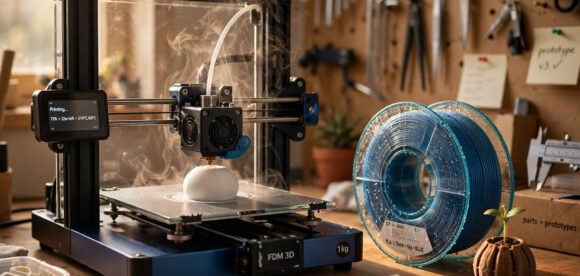
Ask any 3D printer owner about wet filament and you’ll get the same wince. Moisture is the enemy. It pops and bubbles in the hot end, strings across the part, and turns clean prints into spongy failures. An entire accessory industry — filament dryers, sealed storage boxes, desiccant by the kilo — exists to keep water as far away from filament as possible.
A Florida startup called String Cubed looked at that universal rule and built a company on breaking it: it deliberately loads its filament with water. And what comes off the print bed isn’t another plastic trinket. It’s a bar of soap. A solar-generating filament. Fish bait made from real protein. A seed pod that waters itself.
The Real Problem Isn’t Plastic. It’s Heat.
String Cubed’s insight starts with a limitation so familiar that most people stopped seeing it. A standard desktop printer runs its hot end at around 200°C. That’s fine for inert plastic. It destroys nearly everything functional: proteins denature, enzymes die, vitamins and medicines break down, fragrances burn off. The materials that do useful things in the world are, almost by definition, heat-sensitive — which is why, after four decades, 3D printing still mostly prints shapes rather than things that do something.
Founder and CEO Manuel Rendon came at the problem from materials chemistry. His previous venture, Timeplast, developed a water-soluble, time-programmable plastic alternative and shipped functional filaments to thousands of customers. String Cubed, founded in 2023 and based in Winter Springs, Florida, is the follow-up act: what if the filament itself could protect its cargo through the heat?
Printing Wet on Purpose
The company’s answer is a patented process it calls vapor cooling. Water is engineered directly into the filament — the patent filing describes saturating a water-compatible polymer until it forms a hydrated gel, then partially drying the exterior so the material handles like a normal filament while keeping its moisture locked inside.
During printing, that trapped water does the work. As the filament passes through the hot end, the water flashes to vapor and carries excess heat away with it, buffering the temperature the delicate compounds actually experience. Proteins, bioactive ingredients, and other heat-labile materials ride through a 200°C nozzle inside their own evaporative cooling jacket — and come out the other side still functional.
It’s an elegant inversion. The hiss that every printer owner dreads becomes the mechanism. String Cubed holds what it describes as the only granted U.S. patent in “matter-to-matter computing,” with two more applications pending covering vapor cooling for heat-labile filaments and printable photovoltaic materials.
A Catalog of the Supposedly Impossible
The proof of a materials platform is what it can ship, and the company’s early catalog reads like a list of things you cannot 3D print:
- A 3D-printed bar of soap
- A solar-generating filament — printed material that produces power
- Real-protein fish bait
- Bioactive plant vitamins
- Coral reef nutrition — printed feed for rebuilding reefs
- An aromatic cinnamon filament
- A UV-reactive material
- A water desalination filament
The flagship product, Bloominite, ties the whole thesis together. It’s a printed seed pod carrying its own water reservoir, nutrients, and soil precursors, designed to release them in sequence with no human intervention — a small object programmed to behave over time. Rendon’s name for the field is “analog computing”: instead of programming electrons, you program physical matter to behave, adapt, and perform on its own. The company’s long-term project, the Manifester, is a proposed at-home device that would print functional objects on demand.
Whether or not the grand framing lands, the underlying pattern matters for anyone watching this industry: the last decade of 3D printing startups competed on machines. The next one may be won on materials — on what a printer can make matter do.
Why This One Fits the Incubator
String Cubed is also a tidy case study in how early-stage hardware companies now fund themselves. On October 7, the company launched a Regulation Crowdfunding offering — open to accredited and non-accredited investors alike, with a $500 minimum — at invest.stringcubed.com. Its SEC Form C filing sets a $40,000 minimum raise and a $5,000,000 maximum. The money is earmarked for expanding the printable materials library and pushing the Manifester toward reality.
That’s the democratization loop this site has tracked for years: the same internet that let printer startups launch on Kickstarter now lets the public own a slice of a materials-science moonshot for the price of a mid-range printer.
The honest caveats belong in the story too. Crowdfunding investments are risky and illiquid — the SEC filing says so in plain language, and this article is not investment advice. The company’s biggest claims (“world’s first functional 3D printing platform,” the only patent of its kind) are the company’s own characterizations. Wet filament solves a real problem while inviting the classic FFF trade-offs the industry associates with moisture, and the technology has to prove it can hold print quality at scale. Plenty of materials startups have a dazzling demo catalog and no factory behind it.
But that’s exactly what an incubator-stage company is supposed to look like: a sharp insight, a defensible patent position, a founder on his second act, physical products already shipped — and one genuinely heretical idea at the center of it.
Every printer owner knows water ruins filament. String Cubed’s bet is that water is what sets it free.
Sources: String Cubed Regulation CF launch release (GlobeNewswire/NewsDirect, Oct 7, 2026); Fabbaloo, “String Cubed Proposes Using Wet Filament to Protect Heat-Sensitive Materials” (Oct 2026); String Cubed Form C filing, U.S. Securities and Exchange Commission.